Why interdisciplinary
The questions I like don't belong to one department.
Every project I've joined started as somebody else's field. Instead of backing down, I adapted and played to my strengths. When I started research I was more interested in biotech and wet-lab procedures; after I built software tools for one of those labs, it was the engineering that stuck. I'd rather not rule out a subject before I've tried it, and I've found that the most interesting problems lie in the intersection between fields.
The lattice below shows how my interests connect in my head. I have no doubt more keywords will appear as I take on new topics. Drag a node to pull on it.
Current work
Can a chatbot perform accurate and safe psychiatric intake?
Scroll through the study. The figure on the right follows along.
Same patient, same environment, two interviewers.
Clinicians and large language models each conduct timed intake interviews with the same simulated patients. I designed the protocol and built the platform that administers, records and transcribes every session, so the two conditions differ as little as possible.
Scoring an interview.
I built a multi-metric evaluation framework that rates each interview across clinical domains (coverage, risk assessment, empathic depth).
What does it mean?
The results aren't in yet, so I won't make any generalizing claims. I expect that LLMs and clinicians will each have their own strengths and weaknesses when it comes to intake.
So what?
We hope our platform becomes the blueprint for benchmarks in intake tools and medical chatbots as a whole. While this is a new exciting field of research, we recognize the importance of safety and proper testing before deployment.
Other research
Can RL agents help us understand human emotions?
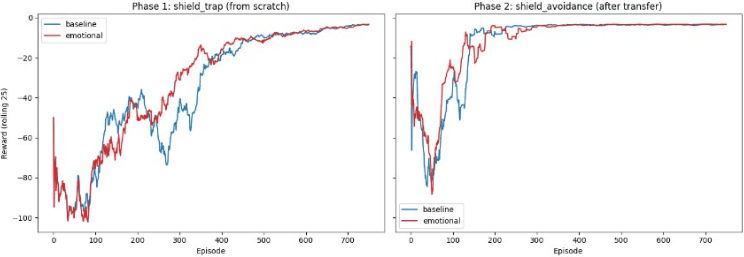
I am researching how emotion-augmented RL agents compare to baseline ones, benchmarking both in a custom environment I built on learning speed and cumulative reward. My current question is whether mood affects an agent's ability to change policies within a familiar environment.
Reading fear out of a night's sleep
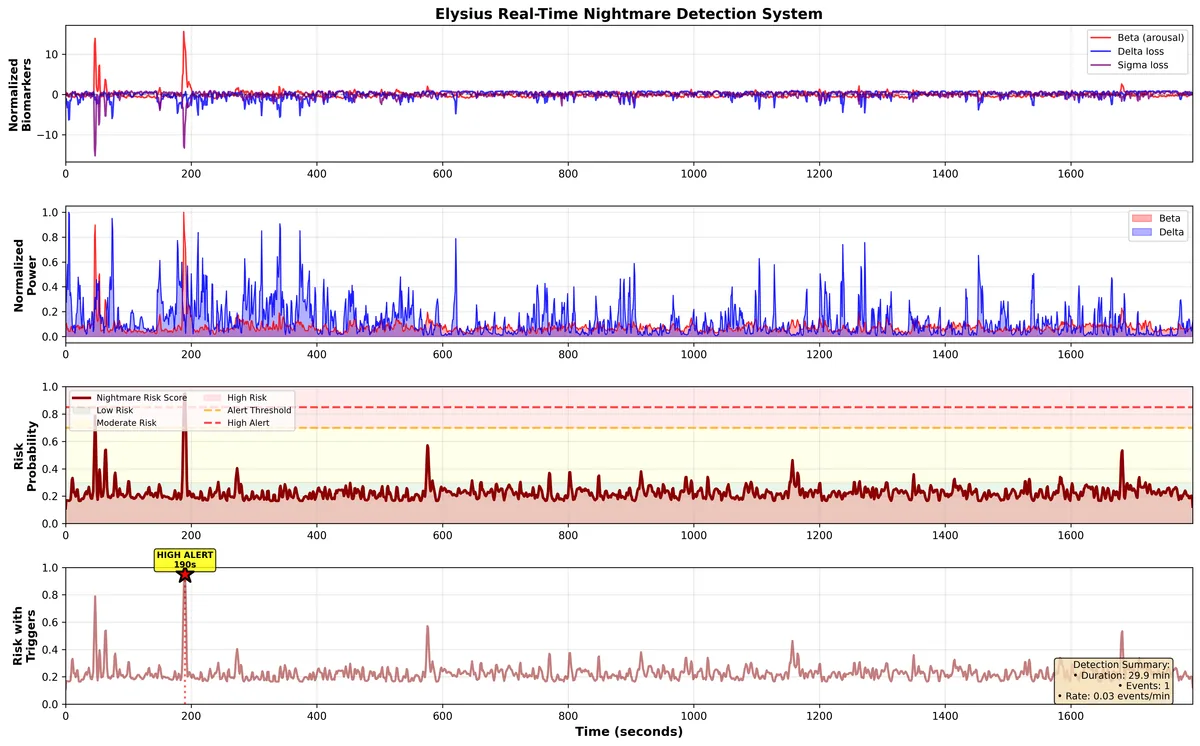
I created a batch EEG pipeline scoring nightmare and hyperarousal risk across 20+ subjects, with ablation-validated risk components and a hardware-agnostic streaming layer holding about 12 ms mean latency, so the same code runs offline and at the bedside.
Space-related open science research
I do open science through NASA's Analysis Working Groups, where I am a member of the Brain, AI/ML, and Microbiology AWGs. I built a five-model ensemble predicting retinal apoptosis and oxidative stress from RNA-seq in spaceflown mice, and I ran an analysis comparing microgravity-driven change to Alzheimer's pathology in mouse mitochondrial genes.
Beta-amyloid structure tooling
I created an open-source Python package for molecular modeling and solid-state NMR analysis, along with the pipelines that turn raw spectroscopy into publication-quality figures.